Installing above-ground swimming pools partially in the ground has become more popular than ever before. This is mostly because more people can find out that it can be done AND that the cost of inground pools has skyrocketed.
Sinking an above-ground pool in the ground some is not that hard. A hole has to be dug much bigger than the size of the pool, then the pool is installed in the hole, and after the pool is complete with water, the bigger hole is filled back in around the pool.
This article is focused on replacing the earth back around the built pool. This is called “backfilling”.
Backfilling an above-ground pool that has been partially buried in the ground usually only requires waiting until the pool is filled with water and then filling the hole around the pool with the same earth that came out of the hole. If the pool is deeper in the ground than two feet and/or the earth is very sandy, then reinforcing the earth or building a retaining wall is recommended.
For the sake of this article, I’m going to assume that you have either decided to sink your above-ground pool partially in the ground or have already done so and want to know about the backfilling.
If you haven’t yet decided on whether you are putting the pool in the ground some or not, then read 11 important things to know about sinking an above ground pool in the ground
Generally speaking, backfilling an above-ground pool is simple but some overthink it. Here are some tips to help you know the best way to do it.
11 THINGS TO KNOW ABOUT BACKFILLING AN ABOVE GROUND SWIMMING POOL
#1 When digging the hole (or having it dug), leave piles of dirt around the hole
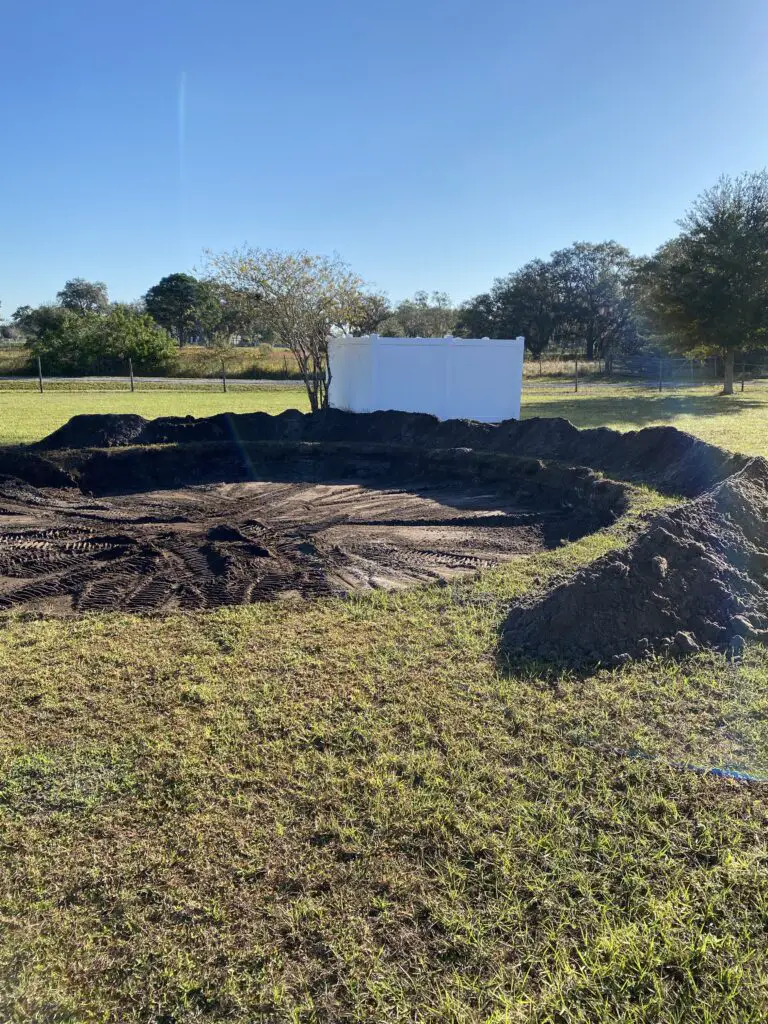
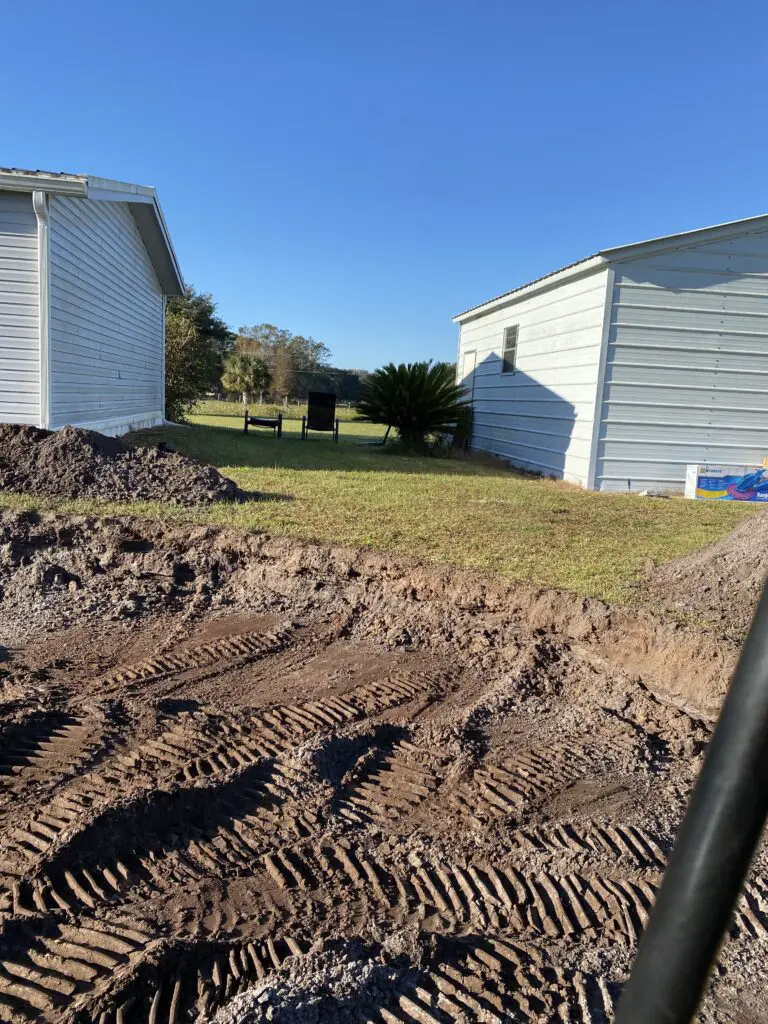
The size of the hole that needs to be dug to install a pool has to be bigger than the pool size. Personally, when installing semi-inground two-plus feet down, I like the hole to be at least three feet bigger than the pool size.
As an example, a 24’ round pool (most common size) will require a 27’ round hole. This means that when the pool is installed, there will be more than a foot left all the way around the pool that will need to be filled back in with dirt.
Some will make the mistake of piling the dirt far away from the hole when digging. This means that they will have to machine or wheelbarrow the dirt back around the pool when backfilling it. And that’s a lot more work than if you leave some piles around the hole.
Leaving piles of earth around the hole make it easy to backfill. When the earth is right next to the hole, all you need then is a shovel to get the dirt around the pool. Some pools installed in tighter spots may not have room to leave dirt. In that situation, you will have to wheel barrow the dirt to the pool for backfilling.
NOTE: If you ran into any irrigation lines that need to be re-routed around the pool, do that before backfilling to use the open area around the pool. No sense in digging twice
#2 Fill the pool with water before backfilling DUH!!!
To many of you, this will seem very obvious. But not all of you will know this.
A TRAGIC BACKFILLING STORY
About ten years ago, I was part owner of a website that sold above-ground pools. A guy(in Indiana if I remember right) bought one of our pools and installed it partially in the ground.
To make a very long and tragic story short, he installed the pool in a three-foot deep hole and then put the dirt back around the pool before he filled it with water.
The result was that the dirt crushed his pool wall inward and destroyed his brand new pool.
A small cave-in or two can be fixed, but this guy went big and backfilled his pool all the way around very quickly. And the wall crushed inward to the point that it couldn’t be fixed.
When he called me and sent me pictures, it was sad because all that I could do for him is tell him the bad news (that he destroyed his new pool) and offer him a replacement at cost.
This poor guy was so upset with himself, that he decided to push the pool completely into the hole and bury it. That’s right. He said “screw this”, completely buried his pool, and chose not to replace it. Very sad.
A traditional above-ground pool only has a thin continuous roll metal wall and is not designed to handle any inward pressure. It can handle outward pressure very well since it’s engineered to hold water above the ground, but not the other way around.
Once the pool is filled with water though, the outward pressure of the water in the pool will allow for inward pressure and weight made by backfilling very easily.
As long as the pool is filled with water, backfilling cannot harm the pool.
#3 If you can, wait a couple of days before backfilling
Usually, if there’s going to be a leak or problem with an above-ground pool, it will happen in the first few days of the installation. Leaving the pool open (not backfilled) will allow any potential issues to be fixed much easier.
A SEAM SEPARATION STORY
About three weeks ago, I installed a 15’ round that was about 24 inches off level and sunk an additional six inches. This means that half of the pool was in the ground about 30 inches.
The earth at this pool site was pure white sugar sand, which is probably the loosest earth that there is and therefore not good for backfilling.
In the last ten years or so of my pool installing, I’ve noticed that about one in two hundred vinyl liners will have a manufacturer’s defect. And the defect is when one of the seams in the liner separate and causes a hole.
This 15’ round pool wound up being the one in two hundred with a seam separation. Fortunately for this homeowner, he waited to backfill and discovered his pool leaking in time. He then was able to easily replace his defective liner without having to worry about his pool caving in from a sand backfill.
When a pool is newly backfilled, the earth is at its loosest making the pool most susceptible to caving in if it has to be drained.
When the earth is backfilled around the pool and has a chance to settle in, pack down, and have roots and vegetation grow within it. It then stays much firmer against the outside of the wall when the pool is emptied (like during a liner change). So, the longer you can go without having to empty the pool, the firmer the earth and better the chance of not getting a cave-in.
#4 It’s perfectly OK to use the same earth that came out of the hole for backfilling
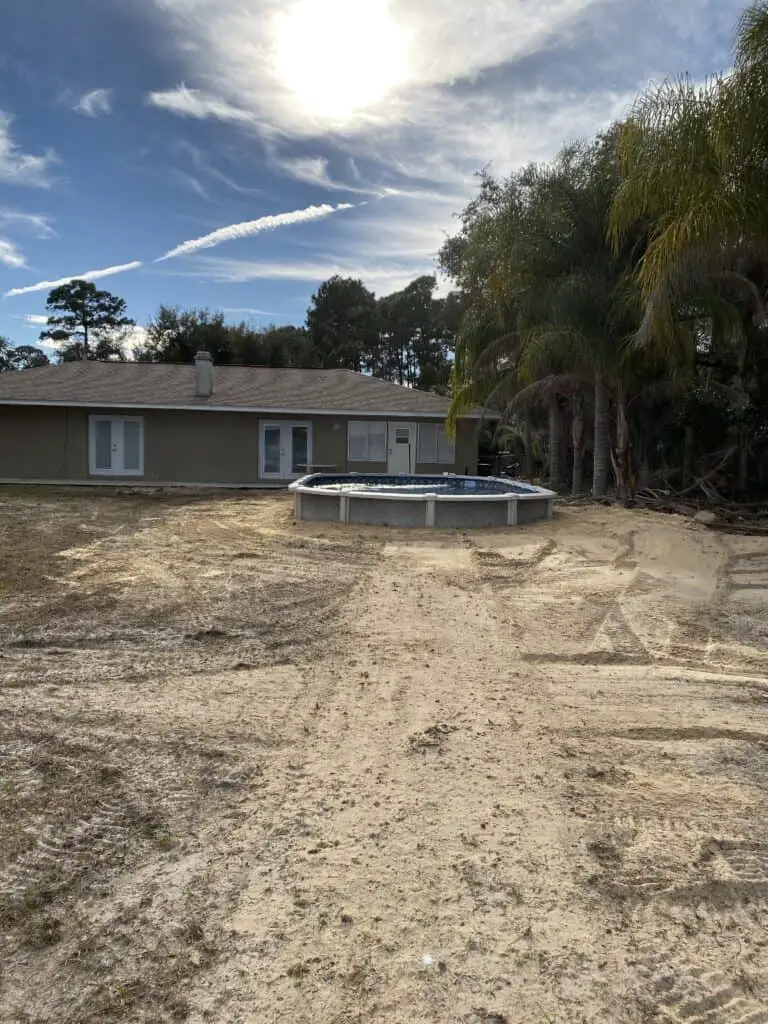
I have people commonly ask me what material should they use for backfilling. Some think that rock or some special type of earth is needed. It’s not.
The earth that came out of the ground is usually the best, easiest, and least expensive material for backfilling. The concern here for some is that the earth will cause some rusting or water retention. In almost all cases, the earth will not cause any issues for the pool’s wall or uprights. Don’t worry about it.
I have very rarely seen the outside of pool walls rust from being in the ground. And if the worry is about erosion or frost heaving, then what you backfill with will have very little to do with preventing those. I’ll get to those concerns later.
#5 Backfill to a little higher level. Some settling will occur.
Dirt that has been in the ground for a while is very compacted. What compacted really means is that it doesn’t have any air and/or water in it.
When putting dirt back in the ground, there will be a lot of air in it. And eventually, that air will release and the earth will settle and pack down. This is why you want to backfill a little higher than what level you want the earth to ultimately be.
And you don’t have to worry about compacting the backfill. While backfilling, I will sometimes push some areas down some by stepping on them, but that’s about it. Don’t bother with a hand tamper or compactor. That will just be a waste of energy and time.
#6 Adding a moisture barrier or painting the outside of the pool is not recommended
During my 35 years of installing above-ground pools, I have seen some crazy stuff. Some of it was what some do to try to protect the outside wall of their sunken pool.
I have seen homeowners line the outside of their pool with roofing felt paper, paint it with everything from Rustoleum to tar to liquid rubber. These things take a lot of time and some can cost a lot of money.
The verdict of 35 years of observation is that doing these preventative things are a waste of time. In truth, I’ve seen some of this stuff do much more harm than good.
Any process or condition that causes moisture to get trapped is a very bad thing. Allowing the pool wall to breathe and dry if it gets wet or stay dry or stay wet is best overall.
Metal in the earth (that isn’t thick aluminum or stainless steel) will eventually corrode away. So will metal on top of and above the earth. Just like animals, metal is breaking down and dying the day it’s made. Sometimes the rate of corrosion is faster and no one knows why.
I have seen pools rust prematurely in the ground and above it with no clear explanation. And I have seen pools have no rust for 20 years in all conditions (wet, dry, in-ground, above-ground) also with no clear explanation.
If you are the type of guy who has to try to control nature, then you will most likely go ahead and try to protect the outside of the buried pool wall in some way. That’s cool, bro. Be you.
If you are on the fence about it, then let a guy who has been around above-ground pools for three and a half decades give you a nudge toward not worrying about it. The buried pool wall will be fine.
#7 If your earth is loose (like sand) and you are more than one foot down, consider reinforcing the earth.
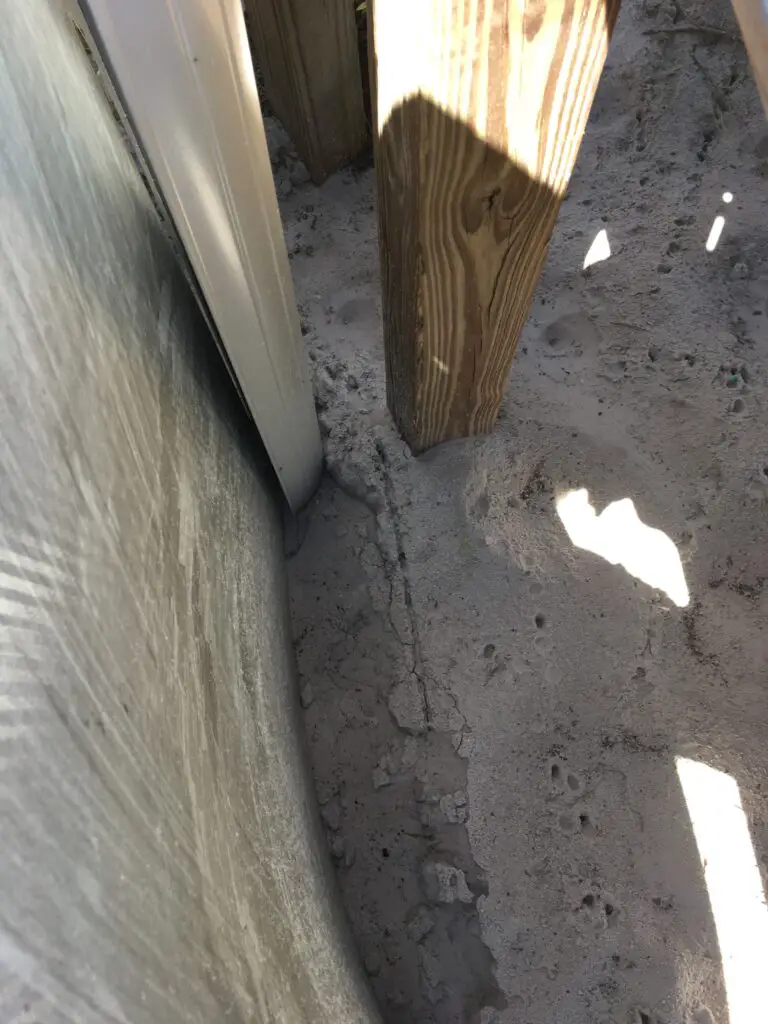
As long as the pool is filled with water, what is around the outside of a buried above ground doesn’t at all matter because it’s impossible for a pool to cave in when full.
When the pool has to be emptied for a liner change is when there can be a problem. And if the earth is loose, it can press against the empty pool wall and start caving in. This is not good.
If the earth around is firm or if the pool is only a foot or so in the ground, you don’t have to worry above an empty pool cave-in. If down more than a foot or the ground is very sandy, then something should be done to firm up the earth.
Sprinkling in some concrete when backfilling will help keep the earth firm when it comes time to change out the liner.
#8 Backfill with regular earth, then add rocks or mulch on top.
Some will think that they have to backfill with rocks all the way down. Yeah, no.
Adding rocks or mulch around the outside perimeter of the pool is recommended and a great idea. When your pool is in the ground some, you only need a top layer of rocks or mulch for preventing erosion or keeping the pool’s wall from grass or other foliage growing against it.
Backfill the pool with the earth that came out of the dug hole. Then put a few inches thick of rock or mulch as a top layer and you are good.
#9 If your area has frost heaving, build a retaining wall
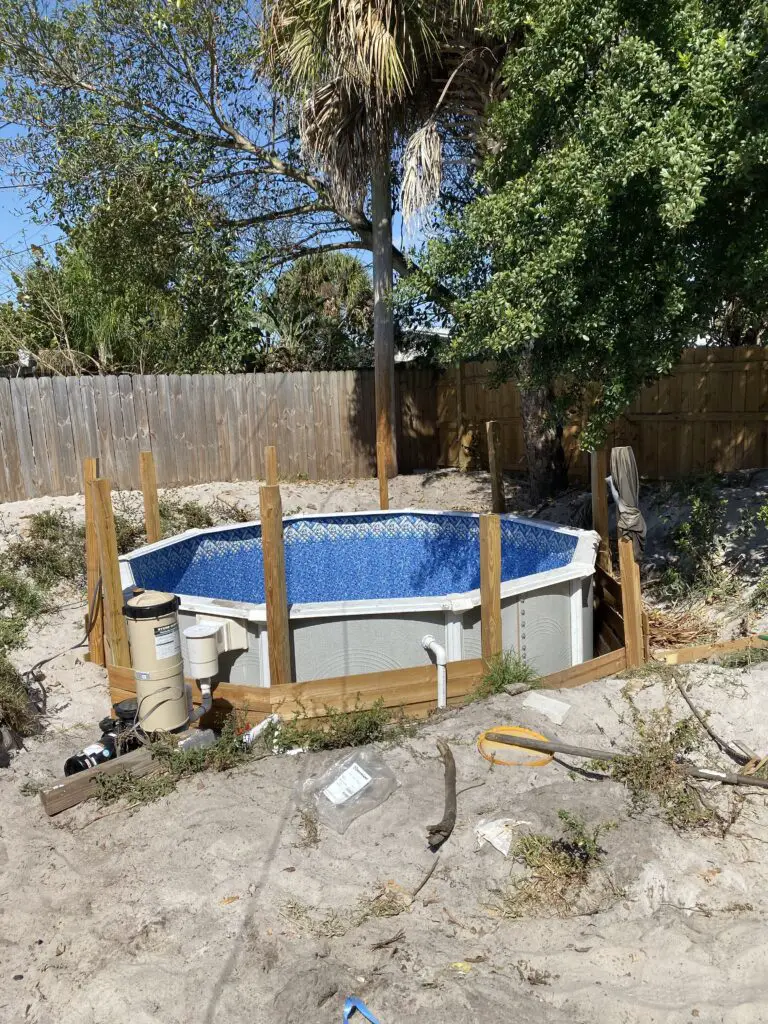
I install above-ground pools in Central Florida. Here, we have our own issues with the ground, but frost heaving isn’t one of them.
I don’t have any personal experience with frost heaving but have seen what it can do to an above-ground pool in the ground. And it’s not good.
Frost heaving is an issue only in the extreme north. This is where the ground freezes, then thaws, then freezes again. This makes the earth expand, then contract, then expand again.
What frost heaving can do to an above-ground pool that is in the ground is push it upward. And it won’t push it upward evenly, so the pool can get pretty badly uneven after just a winter or two. Nope. Not at all good.
To prevent your pool from being affected by frost heaving, it’s best to keep the pool completely out of the earth. The best way to achieve this (if you want your pool in the ground some) is to dig a big hole and build a retaining wall around it. This will keep the pool (that is in the hole) completely out of the earth.
Retaining walls are not cheap or very easy to build well or correctly, but if you are in the extreme north in an area with frost heaving, I recommend it.
Note: There may be another way to prevent frost heaving from moving your pool. My advice is to ask a concrete contractor local to your area. They most likely will know how to deal with frost heaving well.
#10 If planning on building a retaining wall, build it before installing the pool.
You only have to build one retaining AFTER a pool is installed to know it’s best to do it first.
Retaining walls are much easier to build if you have a lot of room in front of it. Build your retaining wall at least one foot bigger than the size of the pool (I recommend 1.5ft) so there’s enough room to install the pool afterward.
All retaining walls aren’t equal. Some will only use some plywood and 4×4 lumber to hold back the earth. Others will build theirs with cement blocks made for retaining walls. And everyone else will do something in between these two extremes.
How much you spend and how well (or poorly) you decide to make your retaining wall is up to you. I’m not a fan of overbuilding, but you do want a wall that will hold the earth back away from the pool wall for many years.
The earth has a way of reclaiming what it used to be. Do some research on retaining walls because poorly made ones will fail quicker than you think. At the very least, use pressure-treated wood. Lol.
#11 Using bags of concrete to reinforce the earth? Don’t have to add water.
Using bags of concrete to help firm up loose backfill earth is a great idea. It’s fairly cheap and accessible as every hardware store carries them. The bags come in different weights too, so you can choose how heavy you want to deal with.
While shoveling the dirt back around the pool, occasionally sprinkle in some concrete. You don’t have to mix the concrete with water first. The dry concrete will find the moisture it needs in the earth in a day or so.
Having to mix the concrete with water first would make this a much harder job. So it’s a great thing that we don’t have to do that.

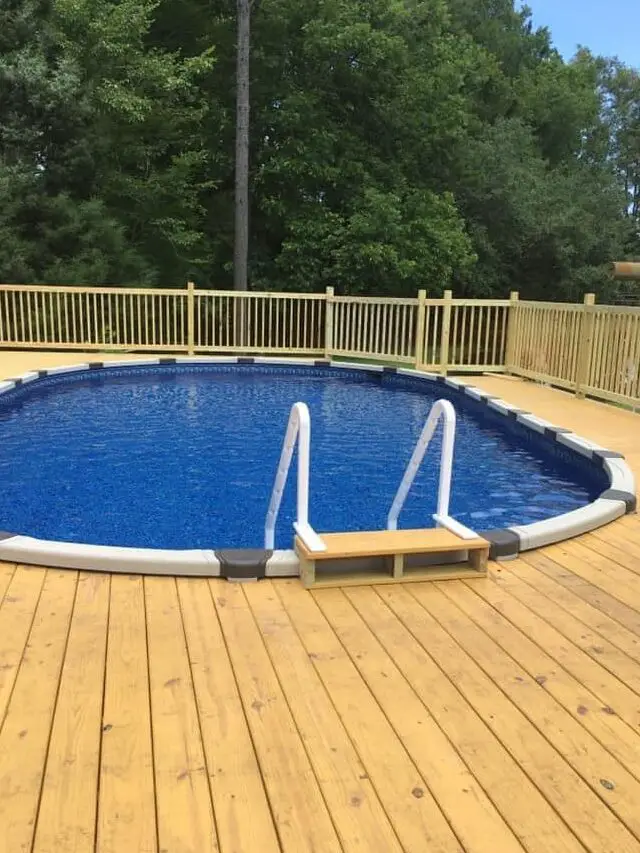


I just read your article about backfilling around an above ground pool. We are considering buying g a 5 yr old pool, it’s in great condition. Our concern is one end of the oval pool is kinda build into a slopping yard, Family Leisure, local pool dealer, said they’d have concern about rust, but when we have purchased new pools, we were told that pools are made not not to rust.
What is your take on the condition/integrity of the pool that has been in dirt?
Well I guess pools are made not to rust, but some do. Corrosion happens both in the ground and above it. I have made no connection between pool parts in the ground and premature rust. This used pool in question is just as likely to have no rust where it is in the ground, but have some on the other side(where it’s completely out of the ground). You never know until you get the liner off of the wall.
I have a fully in ground modular/vinyl pool and was just planning on filling with the sandy soil I took out. The pool is currently filling up (Tuesday) and my plan is to get some friends over to backfill on Sunday. Is this ok? How would you recommend doing this please?
It depends on what type of pool you have. I don’t know what “modular/vinyl pool” is exactly. Please tell me the model and maker of the pool and I might be above to help.
I live in NE Florida and we are sinking a 24ft X 54” half in ground. When we backfill using original dirt and mix in some dry concrete mix with it, do you recommend using ready mix that has rocks in it or no rocks? As I understand it, using low pressure rated concrete mix with no rocks will work as your just trying to stiffen up the dirt compaction. Am I correct?
Yes you are correct. I recommend the concrete with the rocks because it costs less per bag. You could use cement only though the same way.
Does all this apply to oval pools as well? We have a 21×43 going in late May. It will be about 24” below grade all the way around. We are in Missouri and have mostly clay soil. My concern is on the long sides
Yes. It doesn’t matter the shape. With mostly clay soil and only 24″ in, you should be fine.
I have a 27′ round pool that according to the mfg it is designed to be buried in the ground. I have it approx 3′ in the ground in some sandy soil the last liner change out I experienced some minor cave ins which made installing the new liner pretty expensive. I have access to some portland cement that is agregate free, can I just pour this cement around the annular space? Most of the annular space is less than 2″. My major concern is where the metal side goes into the track, I don’t want to create a problem
that could be very expensive next time I have to change out the liner.
Thanks in advance for your advice.
If you had to dig around the outside of the pool when changing the liner, then yes. Now would be a good time to “sprinkle in” some bags of concrete/cement as you re-backfill the pool. Just having a layer of cement may not prevent a cave-in during your next liner change, so adding to the mass of backfill earth is key.
We are installing a 12×24 Doughboy and sinking it 12 inches and building a deck all the way around to give it an “in-ground look”. One installer was going to backfill with the original dirt only ($200) while another wants to backfill with slurry ($2200) because he says that backfilling with original dirt voids the warranty. Is this true? Obviously we’d prefer to go with the cheaper option.
With only going 12″ down, you don’t need a slurry. Regular earth will be fine. And I haven’t heard of backfilling with the earth material voiding the warranty, ever!
My warranty says backfilling with original dirt will void it. The backfill has to be sand or sifted dirt.
I’ve seen some weird stuff written on warranties. This would be weird. Loose earth would be the second worse thing to use as a backfill material. Second only to rocks.
Hi! I am wondering if all of this advice only applies to above ground pools which are rated for being sunk in the ground. Is that true? A friend gave us their 16’ round by 4’ deep summer waves pool they bought from poly group: https://www.polygroupstore.com/16x48_round_metal_frame_s/344.htm
Is this a pool you think I could safely sink 2’ in the ground on a medium sloped grade?
Your pool is a soft-sided one. I don’t recommend sinking them in the ground for one reason – They don’t last very long, so when you replace them, you have to dig the hole out again and backfill every time you replace it.
Good afternoon, I need some advice…
We just recently installed a 24 pool last year the ground is hard clay and very solid, however, we had taken 12’’ of soil out on one end and the other sits flush to the ground. Now that the pool is level do you recommend backfilling the side that is flush? I just can’t picture how o would landscape around the pool because now the backfill will not be level anymore.
Thank you, jim
I don’t recommend adding earth next to your pool on the side that is completely out of the ground. That would definitely look unnatural. I think pools installed on hillsides look just fine when landscaped.
We just got a above ground pool , 21×52 deep . Instead of paying thousands of dollars for a retaining wall we are planning on backfilling the slope side apprx 2 ft. With that said . What are the steps for backfilling with dirt and at what Pooh do you recommend draining pipe and should I put Gravel layer above or below drainage pipe .to redirect water around pool to low side of yard. We also planning on putting water barrier 6mil plastic to keep grass and weeds out and the lay a layer of decorative stone around base ..
I’m really not sure if you need a drainage pipe around your pool. If you had a retaining wall and are up north, then yes, drainage is needed behind it to help prevent the wall from moving over season changes. With an AG pool though, I just don’t know if this is needed as it won’t prevent frost heaving either.
A plastic barrier is ok outside of the pool. I just wouldn’t rest any plastice next to the wall at all.
We just had our agp installed and we’re waiting for the electrical to be finished so we can backfill. Our pool is about 1/4 filled right now. I’m worried because today it poured! The trench around the pool is full of rain. Should I be concerned?
No it shouldn’t matter as long as you didn’t have any erosion (moving water carrying away earth next to the pool).
Had a 24′ round installed and dropped 2′ to be semi-aboveground. After filling, deemed pool is too massive for the yard. Plan to empty and return. Will buy an 18″ round to be installed same day as takedown. Any recommendations? Specifically regarding supports and backfilling since there is a 6 ft difference in size. (Central FL)
Nothing additional except that you will now need a lot of extra dirt (if you had it hauled away).
I am installing an above ground pool and sinking it 2 feet into the ground. I live in Michigan and have mostly clay soil. Will clay soil and some cement sprinkled in work as back fill or is just the clay soil okay?
Any other recommendations?
If your soil if very firm due to having a lot of clay in it, then you shouldn’t need to reinforce it with cement. You’ll be able to know how firm your earth is when you dig the hole for your pool.
We just dropped a 52″ above ground pool about 24″ down, leaving 28 out of the ground. 1ft gap all around. So now that we’ve researched, everyone is saying not to backfill with earth bc it will collapse once you change the liner. (How do we know how long it takes for the earth rooted again, 1 yr?) I guess my question is, should we go ahead backfill the entire 24″ with earth and sprikle concrete? Then add rocks on top of earth? One guy recommended only backfill 1 ft and the rest rock. What’s your advice?
Depends on your earth (like it says in the article). One thing that I wouldn’t do is add a foot of rock like your “one guy” suggested. Rock will likely never create a firm wall around your pool and you will have a much greater chance of a cave-in during a liner change. Just use the earth you have and if not firm (sandy), then sprinkle some concrete in.
Just installed a 33′ x 54″ round pool on a slope. The uphill side is buried 48″ deep. Continuous Slope about halfway around pool. Half the pool is above ground. Can I backfill with my clay soil or should I put a retaining wall in because of the pool buried so deep.we have approximately 2′ outside the perimeter of the pool to backfill.
48″ is very deep in the ground. If you have a lot of clay though, then the earth should be very firm. Retaining walls are expensive and laborious(especially when the pool is already up), so without looking at your situation, I would say you are good to just backfill with your earth.
Hey Rick I’ve done the same exact thing you did with your pool, it’s in the ground about the same depth 48″on high side. I was wondering how yours is still holding up?
We are going to backfill our above ground pool. We live in an area where the ground is clay so no loose earth. A landscaper recommended we use lime to backfill. At some spots we will backfill above 2 feet. Have you ever heard of anyone using lime? Do you recommend this? Thanks
I have not heard of anyone using limestone, but I’m sure it’s been done. I have no experience with it, so I can’t say either way. Why not use the earth that came out? If it’s mostly clay, that would be good.
I just got a 12’X24’X52″ oval pool built and I needed to excavate roughly 16″ on one side of the pool. That slope tapers fairly quickly. I live in MInnesota, and am wondering if you think I would have issues with one side of the pool being backfilled? The soil is a clay loam.
With only 16″ and clay, no issues.
How many years after install should you re-backfill or add more dirt around the pool.. I think mine has settled of course and it’s not built up as much as it used to be. Should I remove the rock and add more dirt?
I’m sure some of it has washed out with time and I just don’t want to jeopardize the structure..
I have not heard of anyone having to re-backfill after years, so you’re my first. You can can add more if it’s low though.
Hi,
I just had an 18 x 33 ft x 54″ oval above ground pool installed. One side is level with ground and other is slightly in ground. The one corner of the pool is about 18 -20″ deep and tapers along the long side of the pool to about 10″ deep. Was considering putting french drain pipe around the one side but not sure i need it. to get any kind of slope to the other side the pipe would be even with the ground. The pool is mostly at high point of yard. So probably not a lot of water. Location is Cincinnati and mostly clay. Mostly just concerned if i backfill to 18″ in one corner and have to drain pool to replace liner at some point will I have problems with cave in.
Second concern is oak tree about 25 to 30 ft away. It is already about 50-60ft tall. When digging for pool there were some small roots about a pencil or more thick. Do i need a barrier or not to worry? I did put a Rhino pad down under liner.
Last concern is frost heave. Cincy is not too far north but just thought i would ask since I read it in comments. Any concerns? THANKS!
Live in Ohio and want to sink pool 6” to 8” inches to meet up with deck. Do you think that is a concern with our cold winters? Your article indicates it is but also references 24” or more.
This shouldn’t be an issue at all unless your area has “frost heaving”. You’ll have to check that out locally.
Great article. Even my pool company wasn’t sure what material to backfill with. I made a rookie error and I could use some advice please. I made sure the skimmer hole was in a good position but wasn’t paying attention to the inlet hole. My kids and I did it and it’s our first time. So we have wall foam up and foam cove as well as obviously the pool bolted together. Do I Drill a 2” hole through the 4” leg for the hose to go through which voids the warranty and weakens the pool leg, do I take apart the pool and restart, or is the a way to shift the pool wall 4-6” while bolted and partially in the track bc yes the wind blew it over while I’m at work. Now some of the track is a little raggedy but not too bad. Wall still looks good. Thanks Tim
I’m not clear about your situation. Are you saying that the return opening in the wall is behind an upright? If so, yeah that happens.
That happened to me about 33 years ago when I had my helper install a pool while I was on a weekend vacation. We made a hole in the upright (leg)
My advice is to use a hole saw and make a hole in the upright(leg) in question so you can attach the hose to it. That would be better than taking the pool back down and moving the wall over.
Yes that’s exactly what I meant to say. Thank you for your time I really appreciate it because it’s hard to find anybody going to give you pool advice or even help for that matter. After installing a pool I see why nobody wants to do it lol.
Well I guess I should’ve said we were first time pool installers. It’s the metal wall not In the right position that we are dealing with. Sorry I wasn’t clear about it in the other post.
Just installed a 27’x54” round pool in PA. One side is 41” in the ground, sloped away from the pool. The other side is even with ground. Would it be best to build a retaining wall around the pool from level ground to peak of slope or just backfill 18” and regrade at less of slope?
Depends on the firmness of your earth. 41″ is pretty far in the ground, so if your earth is not very firm, I would go with one of your other options. And which of those really depends on your preference. Both will work.
Hi. I have a 16′ x 26′ above ground oval pool on a very sloped backyard. Pool is level. Just put in a new wall and liner as the old one was leaking (it was old) so I had to dig the dirt away from the wall. The high end (which is annoying as it’s under a deck) had the earth up about 2′-2.5′ high against (4′ deep water in the pool). It then tapers such that about half way along the pool (the long sides) it is about 1-1.5′ deep and by the back end it is flush to the ground. On the high ground end, there is a deck that goes about 10′ from the pool (there is dirt/earth underneath) and then beyond that about 25-30′ feet of interlock/patio (so water all runs towards the deck and dirt underneath. The original installer had a trench of gravel down near the base with heavy garden fabric between the gravel and all (as I discovered while digging) halfway around the pool (high side) but no drainage pipe. Pool wall was corroded only on the in-ground half and had some wall leaks. So, trying to sort out if I should put a drainage pipe in from the high end to down along the sides to the back and if so, should I put plastic (?) against the wall as the dirt that was removed is full of rocks (both gravel and the silly amount/layers of river rock that they had (below ground level a ways. I hand removed all the bigger river rock but lots of small rocks left…1′ or more wide). Dirt was decently compacted (clay when I got below pool level but just regular earth above it). I’m in a climate with all four seasons (near Toronto, Canada actually so think Buffalo?) but haven’t witnessed any ground heaving. I’m primarily concerned about pool wall damage (either from rocks or water/rusting and any erosion of the sand underneath the pool liner bottom). I’m really confused about putting in a drainage pipe (a guy nearby with a smaller new round pool, put an O pipe all around his). Nobody I ask seems to know what to do. One pool place said not to backfill but how can I leave that trench there right where water will travel down to? I have read your other advice so thought I’d outline my situation (way too long, I know!) to see what you think.
So my biggest question is about the existing wall rust and how it was just on the in the ground side. This may have just been a coincidence, but I can’t know unless I saw it. And even then, I might not have been able to tell.
Generally, a wall won’t rust just because it’s in the ground. And if your pool was more than 10 years old, then all bets are off as you got some good years out of it.
I don’t think a drain would matter. Drains typically in the north create a place and a path for excessive moisture to go, but it doesn’t necessarily keep the earth dry, which means the earth next to the wall may stay wet with a drain. This defeats the purpose when thinking that wet earth causes rust on pool walls.
So the drain is just to prevent the earth from getting water logged from melted ice, then a refreeze which expands the earth and pushes stuff around like it’s nothing (like a stone retaining wall). Above ground pool walls generally have enough outward and inward flexibility to handle that. With frost heaving, the concern is that the ground beneath the wall will expand and push it upward. Once pushed upward, it will not fall back down and in place, therefore leaving the pool permanently off-level. And you didn’t have that issue.
If your wall rusted out from the outside earth, then that is rare AND I don’t know what you could do to prevent that other than leaving the area open by building a retaining wall, which wouldn’t be worth it as you would have to somehow do that under a deck.
I hope some of this helps.
Hi. Definitely helps and I appreciate your response. Do you think that some barrier (plastic poly sheeting?) might help with the rocky dirt I have for backfilling (reduce abrasion on the wall)?…not necessarily the whole wall, just down low where the rocky soil is prevalent (where I dug down to, lot of gravel that original owner put down there. They had garden fabric…which is was obviously damp where the pool had leaks).
Absolutely not plastic sheeting. It can cause moisture to trap next to the pool. Not good. The wall should be fine as long as your not taking off the coating when backfilling, which would be hard to do.
Thank you for writing this article… it has been extremely helpful in many of the questions and concerns that I’ve had. I didn’t see my issue addressed (or may have missed it).
I had the earth from the dig spread out into 2 berms in other areas of my yard. I only have about 15 linear feet to back fill. After reading all the responses, I should be able to just buy topsoil and maybe sprinkle the ready mix with it to slope it away from pool, correct?
yes correct. And it doesn’t have to be expensive fill. Any earth will work fine since you are re-enforcing with concrete.
We are taking down a 20 year old pool and replacing it. Our yard is on a slope. 52″ high walls and on the high yard side only sticks up 1 1/2-2″ above ground. Originally we backfilled with the dirt we took out. (we have clay soil). Have never had a problem but we have noticed rust where the ground meets the pool wall. We were thinking of using a rubberized asphalt flashing (which would stick to the pool wall) to protect it but as I’m reading your article this might not be a good idea. What are your thoughts on using such a project. (product brand name is Textroflash. I’m in construction so I’m familiar with this product and we did use it successfully over some rust spots inside the pool when we changed our liner about 6 years ago).
If you were me, I guess I wouldn’t do that. If this product was a spray on, then maybe. If you are just sticking it on the wall and uprights of the pool, then if there is any gap at all between the flashing and the wall or uprights, then moisture could get trapped.
If you can stick this product very well to the wall only and inside where the uprights are, then it may be a tight enough bond to never have any moisture between it and the wall. That’s the only way I would consider it. With using it or not, be aware that 20 years is a nice long life for an above ground pool.
We have a soft-sided pool set up in our slopped yard. One small part of the pool is at ground level but most of the pool is slightly in ground (no more than 12” in the deepest). I wanted to backfill around the make it look nice. Would you recommend backfilling with dirt and adding an layer of rocks?
At 12″ deep or less, You can use the earth that came out for backfilling. And yes, a top layer of rock would look nice and work well.
Keep in mind that soft-sided pools usually don’t last very long (although some make theirs last for years), so when you replace it, you will have to dig back around the pool to make room.
You mention sprinkling in concrete during a backfill of an above the ground pool. What does that procedure look like? Layers of dirt then concrete? What’s the best approach? Thank you.
More chaotic than anything. Don’t try to evenly distribute the concrete. I mean, you can try but will quickly learn that it won’t work that way. Yes. If you what to try to be systematic about it, then try layers of dirt, then sprinkle in concrete(dry), then layer of dirt, etc.
We live in Nebraska are are re-installing our oval pool with A-frame buttresses. It was on level ground at previous house. We are thinking of burying it 18″ as we don’t want a monster staring at us from the patio, nor do I want to look in my neighbors yard. I could not find any info on frost heaving in Nebraska. Typically, it gets cold and stays cold. Do you feel we would need a retaining wall?
I don’t think there is frost heaving in Nebraska either, but I would make sure. Otherwise, I think you are OK 18″ down. Check the earth when you do the dig. If the walls of the hole stay firm, you are good.
I am installing a 18×40 high quality pool in my sloped yard and on one side I want to backfill to 4 inches below the top rail and pour a concrete patio right to the pool which would be just under the top rail. The opposite side would be close to ground level. Do you see any potential problems or is a retaining wall needed? The ground is topsoil but mainly clay.
Yes I see a potential for issues when you have to drain the pool. The biggest problem that I’ve ever seen with a cave-in is when a concrete deck is poured directly to the pool and the pool is all the way in the ground. When the earth starts to cave in under the deck, there is no way to shovel the earth away (because the concrete is in the way. Now, if your backfill stays firm, you’ll have no issues. But who really knows if it will until the time comes?
I just had a pool installed into a hill in my backyard and the pool is full exposed on one side and only 10” above the ground on the other side. It is filled with water and back filled. I want to pour a small concrete pad in front of the side that is 10” above the ground. How long do I have to wait before I get the concrete installed so the backfill can settle? Is the concrete going to create too much pressure on the side of the pool? Thanks I’m advance.
I’m hoping that your earth or what you used for backfilling will become very firm as that is very far in the ground. How long it takes for backfilling to completely settle depends on how much rain you get. For a small pad, just make sure and pack the earth as best you can and you should be good.
This is a great article!! I have a question, the high point of our pool is roughly 2′ deep and as it goes around its completely above ground. The pool size is 24×52, hard sided. I believe the brand is Vogue. It does say backfilling voids the warranty but if we don’t our only option is to have hole on that side, which we do not want. We were not left with any dirt he dug out, I believe he just spread it throughout the pad and topped with the sand. We want to back fill that area to have a semi flat surface. Should we back fill with top soil and layer with rock on top? I wish I could include a picture it is hard to describe. The distance between the earth and the pool wall is about a 1′- 1 1/2′.
This sounds like a pretty standard install on extremely unlevel ground. Yes, backfill with your dirt and a top layer of rock should be fine.
I wish I found you sooner , can I mix concert with sand for back fill want to slop and don’t know how high up can I put it on wall ?
Sorry. I don’t understand your question
Hey so i bought a semi inground pool 12x24x54 oval and just had it burried with about 4 inches above soil line was wondering how i should back fill correctly i live in central nj wanted to know if backfilling with original dirt tamping down then throwing concreate dust wetting it down and going later by layer to really compact the soil is a good move or if i should maybe consider adding those 2 inch foam boards around the pool as aj extra barrier thank you so much
Reinforcing just one layer of earth around the outside of the wall may not work as the earth can still cave in above or below it. You are waaaaay in the ground, so I would take this serious. I can’t tell you how many times I’ve had people not listen to someone who knows only to have a major issue when liner change time came.
I like the idea of using foam boards along the outside of the pool to keep the pressure of the earth away, but have never seen this in the real world, so I don’t know how well they will keep the earth from pushing towards the wall in the long term.
I have a new 24′ x 52″ dug in 24″, located in South Florida. The material that was removed looks almost like play sand, hardly any soil. I read through the article in preparation for backfilling. My plan is to take the recommendation and add concrete to the backfill. Question is, how are you quantifying a ‘sprinkle’ of concrete? Is there a ratio mix I can go by to get an estimate on how much I will need? I just don’t want to over sprinkle and spend un-necessary money. Thanks
Each situation is different, so I cannot lock down a specific amount of concrete(bags) to use. To give you an example though, the last time I did this, I sprinkled in 20 -60lb bags of concrete around an 18′ round pool that was 2.5ft in the ground and had very loose sand for backfilling.
Help , pool has crappy instruction
Installed 21” round above ground level with transit the proper way,
Half of the pool is in the ground 8” an other half is at grade , can I fill in 8” Around the half
Also thei is a lightly sloped grade
Hint of y the pool is 8” below grade on half of it !!
What should I do !!!
Yes you can with no issues. It’s only 8 inches down.
I used screend soil so nothing was bigger then a dime in size nice and easy to work with , sloped it high on pool side so water drains away
Going to put landscape fabric on top of dirt ,May even lay In corrugated drain pipe where the slight slope of new top soil from the pool, meet with existing grade
And slopes the opposite way up hill ,
From the base of pool out 14’ inhave a 2.5 ft rise then ground levels off, u thinks drain pipe is needed ? Where the two meet ?my Base under pool is hard pack clay And shale, with a layer of sand 3-5” deep uprights sit on a landscape block recessed in the virgin hard pack , with foam cove and gorilla fabric pad on top , i am a contractor so I am smart with all this , and it’s my
House where we are installing at
Everthing is Perfact level within .5” using a transit
Also have post innthe ground on the high side of the grade for decking , 18’x 14’at the widest part of pool and 10’ wide at the smallest part of pool , hence the square sides of and inground !
Thanks yea the instructions sucks, and internet is full
Of maybes, what if and whole bunch of nonsense I couldn’t find and answer till I found u !!!!
Th
I’m not certain of your situation, however, I rarely think a drain pipe is needed for an above ground pool. Erosion is managed on top of the earth. Unless you have some unique situation where water will river down below. I have only seen that once.
No sir I am just over weary of thing I like it all to be Perfact and 100% !!
Thanks for all your help !!!
Hi
I’m having issues with some small areas of washout of sand under pool either from leak or rain washing it out. It has compromised the sandy cove too.
My question is can the liner be pulled back, and sand added and compacted and liner set back? Or would I need to replace the liner once it’s drained? It’s only a year old.
If you drain, peel the liner back, add sand, then immediately refill, you have about a 90% chance that the year old liner will be fine.
So glad I found you and I hope this makes sense. We had a 30×54 resin pool installed on the upper portion of our property but away from the house. It’s been a nightmare with the install-3 liners and two complete pools. (On our third pump). All that being said, with zero info from the company or installers, I’m at a loss of who to turn to. My question is, on the backside of the pool we have a retaining wall. It’s not finished because of all the rain we have had. And rest of pavers being on back order. Several days of rain and the ground behind the (halfway built) wall a section of the earth just caved. But retaining is still intact. Some mud wash through it though. How high should the retaining wall be? Level with the pool? A foot below the top with earth and then maybe some more gravel? My hope was to pour a 10×10 concrete pad from the retaining wall. Is that even a possibility with knowing the ground erodes like that? For reference, The pool is huge and the pool itself is around 4ft below ground level in about 1/3-1/4 section of the overall pool. Thank you for any advice and I apologize in advance if none of this makes sense!
Usually a retaining wall can be below the level of the earth a little. This is only if you are having zero erosion. If you are having a lot of erosion(which it sounds like you do), then make the retaining wall slightly higher than the earth.
You still want to address your erosion issue though. This is independent of your retaining wall (which is to prevent earth from pressing against the pool wall only). Here’s an article on retaining walls: https://abovegroundpoolsknowitall.com/building-retaining-wall-for-above-ground-pool/