Let me guess your scenario. You just installed or had an above-ground swimming pool installed and it’s now full of water. It’s been a day or two and you notice that a portion of the bottom track of the pool is out and away from the wall.
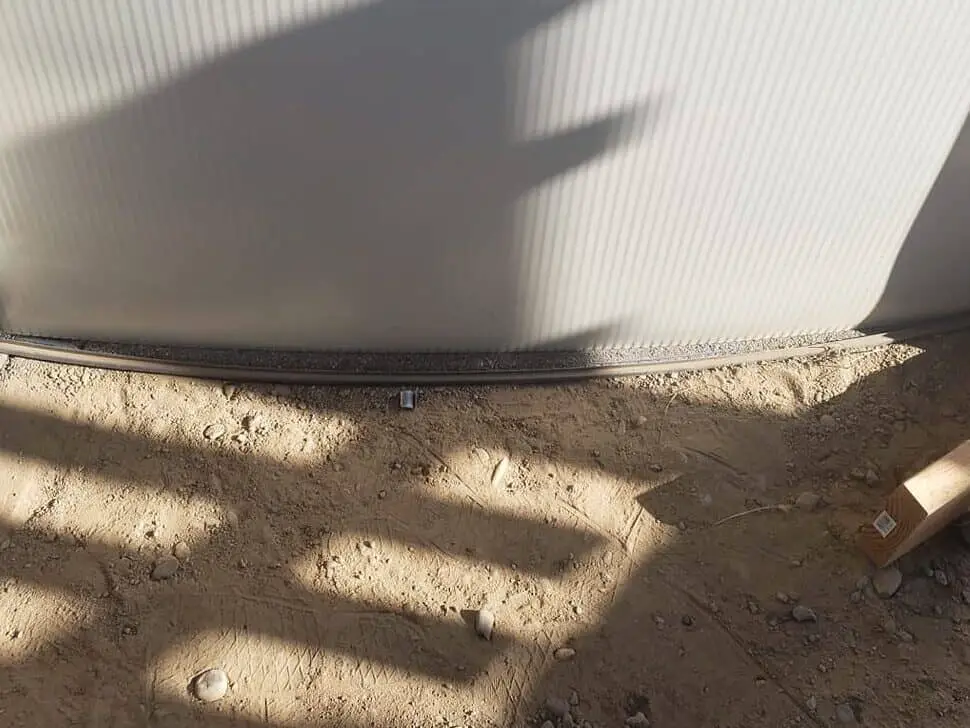
Upon seeing this, you get a sinking feeling in your stomach. Something big is wrong with my pool, you think.
While reading this, take in a breath, hold it, now exhale as you read these words.
“An above-ground pool wall out of its bottom track is most likely no big
concern”
WHY 95% OF ALL ABOVE GROUND POOL WALLS ARE OUT OF THEIR BOTTOM TRACKS
Metal-walled above-ground pools have bottom tracks. These tracks come in pieces and each attaches to a bottom connector plate. This plate is at the bottom of each of the pool’s uprights. That is what you screw or snap each upright to.
If installed properly, each of these bottom connectors will have a leveling block underneath them. This is how the entire bottom track (and ultimately the pool) is made level.
So for example, if you have a 24’ round pool, then it will usually have sixteen bottom connectors that each have two ends of a bottom track piece connected to either side, an upright attached to it, and a leveling block underneath it.
This then would be a round track 24’ in diameter sitting on sixteen separate blocks that are (hopefully) all the same level.
Now, the wall of the pool (which is a continuous piece of metal) is rolled out and sits inside this bottom track. This is what gives the pool its round shape.
Are you still with me?
So, the pool wall is now positioned upright. Sitting in a bottom track supported by sixteen level blocks under each connector. Where the track (and wall) is NOT supported is at each track piece in between each bottom connector plate.
And it’s at any of these points (track piece between each leveling block) that the track can sag down and drop below the wall.
So, if you are looking down in between two uprights and noticing that the bottom track is sagging below the bottom of the wall, then that’s common and no big deal.
This piece of track dropped down below the wall because it (the track piece) wasn’t supported by any earth. This is no big deal as the WALL of the pool didn’t drop out of level. Only the middle of a piece of bottom track.
WHY I COVER THE BOTTOM TRACK WITH DIRT WITH MY INSTALLATIONS
There are a couple of hundred different models of metal-walled above-ground pools. Some of them are very prone to the track pieces coming off of the wall between connector plates.
I cover the bottom track on the outside of the pool. Because I don’t want a call back from a customer two days later when they looked down, saw that a piece of track wasn’t attached to the bottom of the wall, and then think that I did a poor job of installing their pool.
In reality, the track doesn’t have to be connected to the wall in these spots. I do like them to be and stay in place as that looks much better, but it doesn’t matter much.
When I started installing above-ground pools 35 years ago, I was installing four or five Wilbar models that Recreational Factory Warehouse sold. Two of these models were very prone to having the bottom track sag down between the uprights (leveling blocks).
The solution back then was to place what we called “quarter blocks” in the middle of each bottom track piece. This way the track couldn’t sag down and away from the wall. We didn’t bother leveling these small pieces of block with blocks under each upright. We just placed them there as one of the last things before we finished.
I stopped using these “quarter blocks” because they were unnecessary. Don’t have anything against placing a piece of block under each track piece though. I just don’t do it.
HOW TO GET THE TRACK BACK IN PLACE
If this is the case with your pool, then it’s no big deal. As a pool owner, you’ll probably want to get the track back up and attached to the wall instead of just covering it with some dirt (out of sight, out of mind).
This may seem dangerous, but you’ll have to grab the track piece that is sagging down and try to push it up and back with the wall bottom.
This could be easy if the wall is at the exact same curve as the track. After pushing up and in place, add some dirt or a rock to keep the track up and with the wall and you’re done.
Sometimes the wall will be at a slightly different curve than the track piece. This can happen for a couple of reasons. None of which is usually of any issue. In this situation, you’ll have to be more forceful to get the track to snap into the wall.
If you watched me do it, you might think that something is going to break or that I might disturb the coving inside the pool. Sometimes you have to be kinda violent to get that track back with the wall.
If you have tried and can’t get it. Don’t stress too much about it. It can be intimidating to be shaking things directly next to all that pool water. If you can’t get it, leave it and cover it so you don’t see it. You can fix it if you want in a few years when it’s time to change the liner and the pool is empty.
WHEN YOU SHOULD BE CONCERNED
The above situation of the bottom track being down and away from the wall is the most common scenario and not concerning. Sometimes though, the wall being out of the track IS something to worry about.
Before describing a real issue with the track away from a wall, I have to explain some things.
“The main function of the bottom track for an above-ground pool is to make sure it’s installed level and round” That’s it!
In reality, once an above-ground pool is up, level, and in its correct shape(round or oval), you can remove the bottom track and nothing would happen.
The bottom track of an above-ground pool has very little to no structural value. Weirdly enough, the frame at the top of a pool is much more important structurally than the bottom frame.
I know this sounds ridiculous to those readers who think they know things. Engineers are the worse for this. It’s an absolute truth though. I verified this not by using a computer and mathematics (which can be grossly inaccurate in the real world). This is proven by my observation out there in that now strange place called “the real world”.
Don’t believe me? I’m shocked. Quick, go out and find a soft-sided above-ground pool. If it’s too hot for you out there, find the schematics of an Intex pool in your online world.
Notice how a soft-sided pool DOES NOT HAVE A BOTTOM TRACK! That’s right. No bottom track on a product that is up and holding water in a million different yards as you read this.
As long as a soft-sided pool is installed on somewhat level ground AND the top frame of the pool stays mostly intact, it will be fine.
BE CONCERNED IF THE WALL IS OUT OF THE TRACK AT A BOTTOM CONNECTOR OR TWO (OR THREE)
Since the function of a bottom track is to make sure the pool (wall) is level and round during the installation, then if the wall is separated from the track at a leveling point(which is at a connector with a block underneath), then that can mean that the pool is now off level.
It can also mean that the pool is out of shape too as the wall may be either inside where the track is or the bottom track has pushed outward (away from its original round spot.
When the bottom track is out from the wall at a connector plate or two, it’s usually an indication that the wall moved out of place either when it was rolled out and into the track OR when the pool filled with water(and the water moved the wall).
The big concern here is not with the structure of the pool. It’s that the pool may be extremely off level, extremely out of shape, or both. This should be addressed.
FIXING A POOL WALL THAT IS OUT OF THE BOTTOM TRACK AT SOME CONNECTORS/UPRIGHTS
Before attempting to put the track back under the pool wall, I suggest trying to figure out if the pool is both off-level and out of shape. This will help you access your situation and determine whether or not the pool will have to be drained.
TRYING TO DETERMINE HOW LEVEL THE POOL IS
There are three ways to tell how level a pool is when it’s up.
1. Using a laser level/builder’s level
This is what a pool guy like me would use and is the most precise way. I would set the laser up high enough to be able to check the level of the top rails.
To be more accurate, I may remove the pool’s top connectors so I can measure the very top of some(or each) uprights.
2. Looking at the water line in reference to the liner or top rails
Since the pool is full of water, you’ll be able to look at the waterline and reference it to the liner’s tile pattern or the distance to the top rails.
All bodies of water have to be perfectly level. This is best understood by tilting a glass of water. Notice how the water stays level regardless of how much you tilt the glass.
Checking level by referencing the liner pattern(if not a solid blue liner) can be deceiving as the liner may be stretched further on one side of the pool. If the pool is off more than an inch though, you’ll be able to see it with the liner pattern regardless.
Measuring down from the top rails to the waterline will also give you a fair assessment of how level the pool is. Again, this is not as accurate as using a laser, but if way off, this will show that.
3. Eyeballing the pool from afar
This sounds like a dumb way to tell if a pool is level, but your eye will pick up on it if it’s off more than an inch.
Standing 25 feet or more away from the pool, line your eye up with the top of the pool. As you look at the pool, reference the top rails closest to you to the ones farthest. If the pool is level, then the foreground top rails will line up with the background ones.
Do this from a couple of different points always well away from the pool. If it’s off-level, you will see it fairly clearly.
This is the quickest method to tell if a pool is off level. I do this every time I’m coming up on a pool to repair it.
HOW TO DETERMINE IF A POOL IS OUT OF ROUND
An above-ground pool wall moving out of the track at bottom connectors (where each upright is) is a good sign that the pool may be out of shape.
First off, take a look at the pool from a distance. Does the wall look tilted inward or tilted outward as if it’s not perfectly vertical everywhere? Out of shape and/or off level above ground pools can have a “wonky” look to them.
Measure a few different areas across the pool from inside of the wall to inside of the wall.
NOTE: Measuring from top rail to top rail across may not give you accurate measurements for determining if the pool is round or symmetrical.
Using a 24’ round pool as an example, when you measure across from inside of the wall to inside of the wall, you should get a number something like 23’11” consistently.
You could get 23’ 10” in one direction and 24’ in another and that’s fine. Above-ground pools are rarely perfectly shaped (round).
If you get a measurement difference of six inches or so, then the pool is pretty severely out of shape and that’s probably why the wall came out of the track when the pool filled with water. Not always though.
NOW THAT YOU KNOW IF YOUR POOL IS OFF LEVEL, OUT OF SHAPE, OR BOTH, WHAT’S NEXT?
If you have determined that your pool is NOT off level much and close to the shape it’s supposed to be (for both round and oval pools), then try to put the track back under the wall while the pool is full.
You may want to take off an upright or two when doing this so you can see the track and bottom connector better.
Warning: This is not an easy fix.
The wall of the pool won’t move at all. You’ll have to get the track back on by moving it and the connector/s only. Dig a little under the track and temporarily remove the leveling block that is under the connector plate in the area needing the track replaced.
Move the track to fit under the wall. If successful, replace the leveling block to about where it was at about the level it was at and replace the earth under the track. Don’t try to be perfect about this.
If you have an area of wall out of the track that is greater than the distance of one connector plate, then only replace the track under one connector at a time. You don’t want to remove more than one leveling block at a time. This is to help keep the pool level.
If you weren’t successful at getting the track back under the wall everywhere, don’t be too upset about it. This is a more difficult fix than it looks and many cannot be fixed this way(with the pool full).
At this point, you can either live with it (since your pool is level and in the correct shape) or you will have to drain the pool so the wall can move and do the repair that way. This may result in you having to get a new liner or have some wrinkles when done.
If you have determined that your pool IS off level by more than two inches and/or out of shape by six inches or more, then I recommend doing a major fix.
This would require completely draining the pool, removing the liner, and maybe even taking the wall back down. In most cases, the only right way to fix a severely off-level or out of round pool is to redo the bottom track. And that means taking the wall back down (basically a complete re-installation).
REMEMBER THAT 95 PERCENT OF ALL ABOVE GROUND POOLS THAT ARE OUT OF THEIR BOTTOM TRACK ARE FINE AND CAN EASILY BE FIXED OR NOT EVEN HAVE TO BE FIXED
And with the other five percent of pools out of their bottom tracks, they’re usually very visibly off to where you know something is seriously wrong. Also, if the pool is way off, then the liner won’t set well and the frame won’t go together well.
These will be the signs that the pool will need to be re-done.



I am in the process of changing our Liner on a 18×33 ‘ above ground pool and noticed in a small area the bottom track came away from pool wall with the water drained and old liner removed will I have play in metal wall to resecure any tips would be appreciated Tks Peter
Will you have play? You may not. There’s a reason for the wall being out of the track. Could be because there was no play.
You don’t have to fix this (most likely), but if you want to, then remember that the wall is the constant. To match up the track with the wall, you have to adjust the track. They are in pieces, so you can expand or contract it in the area needed. In not having any experience with this, you will most likely have to dig out the area to clear the track which can do more harm than good.
Also, if out of the track on the straight sides, do yourself a favor and just leave it. Are you seeing a pattern with my opinion here? LOL
Thanks for getting back to me, with the water and liner out can’t I just pry the Track up a little that I am sure settled and push the wall back into track and then put either more sand and or a shim or something under that area to help keep track in place ? Appreciate your help Peter
Yes that is good. I used to have to place little (quarter) blocks under each piece of track between two uprights on some models years ago because the tracks would drop down in the middle. It’s fine either way as the wall cannot move downward. The track only helps keep the shape of the wall (when the pool is empty). Nothing structural.
Thank you for your information. We hadn’t been able to find any advice. Our pool had a leak over the winter. We have drained the pool and ordered a new liner and a new bottom track piece. One
piece bent flat and the bottom of the pool wall also bent a bit. We had hoped we could replace the one piece of track without taking down the whole pool wall. Lifting up with dollies wouldn’t do the trick huh? The broken track is still attached at both ends just flattened in the middle.
If just one piece of track, I would most likely leave it alone. It only has a shaping value (not structural). If you must replace it, then I WOULD NOT jack up the wall. That will just bring the pool out of level and you may have a hard time getting it back down in place. I would instead dig around the track that you are taking out and maybe remove one of the leveling blocks on one side to make downward room to remove the old piece and install the new one.
Also, if this is a track piece between two buttresses (if you have an oval shaped pool), then just leave it alone. Trust me!
So, we just got a new liner today. I was filling the pool and the hose fell out of the pool and water ran onto the ground for probably a couple of hours before I found it. Some of the soil around the base of the pool seemed to settle, and one of the pool walls buckled inward a bit. I pulled some of the soil out and noticed the track at the bottom, and that the sheet metal of the wall wasn’t connected. I freaked out a little, and then found this article. 🙂 The track still looks in good shape at the uprights on either side, and the pool still seems to be level and generally round, and it’s about half full of water at the moment. If it doesn’t pop it out as it fills up, I guess I can just cover up the spot with dirt and let it chill until I have to get a new liner. I appreciate the information. My wife will appreciate it even more, since she uses the pool much more than I do. 🙂 Take care.
Thank you. So glad this helped.
This information was exactly what we needed. Unfortunately we fall in the 5% and will need a complete reinstall but it gives me hope that the pool may still be in good shape and not need to be replaced. We have a new liner (needed to change it) and will need to re level the area as the pool sank quite a bit on one side. My question is, are foam coves worth the cost? Many on you tube not only recommend these, but some also suggest using foam insulation board on top of the sand fir a smooth bottom. That adds about 1300$ to the reinstall and wondering if it would be worth it.
Hi. $1300 is not worth it. I would recommend the foam coving though. You can buy it online and have it for the installer. They couldn’t possibly charge much more to install it. I don’t charge any extra to install foam coving.
Most of the $1300 upcharge has got to be with the foam board bottom. It will make the bottom nicer, but how much? If the installer is good, the difference between the two would not be worth the extra cost.
Good to know. As we are having a hard time finding someone with the availability to do the work, I am afraid my husband and I will be the installers along with a couple of extra bodies to help out. Hence my question on the insulation foam board. Most companies are fully booked catching up to last year’s demand for new pool installs. A bi product if the pandemic I am afraid.
My pool had a leak over the winter with most of the water escaping before the spring. We had a few large rain storms that caused the bottom rails to wash down away from the side of the pool. If I read your advice in most cases, should I just backfill around the bottom of the pool, refill with water and call it a day? Seems like getting the pool wall back into it’s track is not imperative. Thanks for your help.
Yes if I am reading your situation correct, just cover up the sagging track so you don’t see it. Out of sight, out of mind.
Good afternoon Dan,
Wow, such great information in this article. I’m so happy I decided to google. That was the first thing I did last summer .
OMG the pool wall is out of the bottom track. I totally freaked out, didn’t know what to do and with the better half off from work , no new pool for us this year. This problem I noticed last summer, that one of our sections of the pool wall came out of the bottom track and the pool wall is resting on or a little in the dirt. I think it is about 20 inches in between the 2 uprights. Our pool is about 15 years old and most of the rest of the walls are about 4-6 inches under ground. We try to keep everything up to date. The grandchildren love to come over during the summer. This is how much it freaked me out. Every time they came over it was ok no jumping in, no sliding off the kiddie slide, no mermaid fins in the water , No cannonballs, basically don’t move in the pool ! Oh nana they would say.
We were thinking what we could do this summer. I didn’t want the pool walls to go and all that water going down the hill towards the neighbors house. I think your great article made feel better.
I may let the grandkids jump in this year.
Thank you
Darlene
Over the winter our 12′ X 24′ oval above ground lifted above the track – still in line with the track – and all the top plates broke. it rose only on the side about 1.5″ which means the top plate no longer can reach the upright side supports. We can’t find anyone to do the repairs as they are all too busy this year. We have had all different advice from don’t use it til it is repaired as it isn’t safe to use it for the summer as is and repair it next year. Also we are being told that it basically needs to be disassembled to be fixed and because its 5 years old it will need a new liner. Any advice you can provide as we are totally lost.
It’s hard for me to visualize your issue. How far north do you live? Is the pool in the ground some? Is this the result of frost heaving? Odd that only the wall rose and the frame stayed on place. If this is from frost heaving, then I cannot advise as I have no personal experience with it. I’m in Central Florida.
If only the wall lifted, then I agree with having to take the liner out and try to get the wall to go down (which won’t at all be easy and may need to come down first).
Hi Dan,
I have an 18 x40 above ground pool that is about 15 years old. I am ready to replace my liner when I noticed 4 of my bottom tracks have eroded and broken a part. I had thought it was only one and bought a replacement track. Do you have tricks to replacing the broken tracks?
If the wall is in the same shape as it’s always been, then you don’t need to replace the rusty bottom track. It should stay in place with no issues. If you want, you can make a bigger cove in that area to help keep the wall in place, but most likely even that is not needed.
Great article. While installing the liner, the wall came out of a portion of the bottom track. The wall is now back on the track but a lot of the dirt and sand was moved around. Paving stones were only put under the butress stands. Should we start all over from step 1 or can we salvage what is done? Would we be able to ensure our pool is level at this point? Any feedback is so appreciated.
If you removed dirt around where the buttresses are, then you don’t have to worry about the wall’s level as they won’t move much(at the wall).
If you mean around the ends of the pool (radiuses) and you didn’t put leveling blocks under each upright, then the wall may be out of level where you dug. If you don’t have the liner in already and just the wall up, then I would take it back down and put blocks under each bottom connector plate and level to the same level as the track is at the buttresses. A laser level or transit is best for this.
If the liner is already in, then see how off level the wall may be and decide if you want to live with it. It may not be off-level at all or just a little.
Thanks for putting this great article online. Very usefull information, well said. With great appreciation I will now fix my pool.
We just installed and filled a 15×26 oval resin wall pool and noticed one track section was out and the pool wall was in about an inch. The manufacturer said to get it back in the track, and remove any spikes that were holding the bottom track in place. I can send a picture. Is this something to worry about?
Doesn’t sound like anything to worry about. And you got a response from a pool manufacturer? Wow. Amazing. That is super rare.
Dan,
15ft round with a wall that came out of bottom rail about a foot and a half on each side of the upright bottom plate. Level is a little off but no weird push-outs of the wall and wall is wall completely follows the curve of the bottom rail. I’m not too concerned but what do you think.
I wouldn’t worry at all about it.
Hi, and thanks for great information! We just finished building our above ground pool and i just noticed (!) that it is out of shape by roughly 4 inches at most. Everything is level and seems good, apart from the shape. Is it a measurement the pool can ”handle” or do we need to dismount it and do it all over? Its an 18 feet pool. Thanks!
At 4 inches out of shape, you can probably see that something is off by eye. Regardless, I have seen many pools off by that much and have no issues for the life of the pool.
My metal wall is buckeling at one if the uprights. It looks like the sand is washing away from underneath. Is draining the pool the only way to fix it?
A wall buckling and it losing some sand coving or bottom have nothing to do with each other. It can only buckle while the pool is filling. Is this when you mean?
There can also be small buckles in the wall at the very bottom and they will be when the pool is full. I’m going to assume this is the buckling you are talking about? If so, you may be able to get it out by digging under the bottom rail and pulling out the patio stone under the upright, then putting it back a little lower. This can stress you out though if you don’t have a lot of experience.
As far as sand washing out from under the pool, that is more than likely from a leak somewhere. I would look for a leak.
That makes sense! It seems looking at the buckle that lowering the stone would make a huge difference. My kids admitted they have been hitting a tube against the top rail at the upright where the buckle is and it seems the top is loosing its shape or even becoming loose at the upright. Obviously we won’t be allowing them to do that anymore but unfortunately the damage is done. When we noticed the buckle we assumed something was weak and were worried the pool would collapse. Will will try to resecure the top rail and maybe we can remove the buckle. Thank you so much for your time and wisdom!
Just setup my first ever pool (15′ round, steel wall) and filled it up. Now I am realizing I might have messed up cause I installed the wall tracks over compacted sand instead of more solid ground.
Should I be concerned about the sand washing away and the liner ballooning out the bottom?
Would adding some 1/4 minus gravel all around and up against the pool wall help keep the sand in place? Maybe some ground fabric?
**(The base consists of compacted level earth, patio tiles under each leg, and 2-3″ compacted sand level with tops of tiles everywhere else)
If you applied a proper coving, then you won’t have to worry about this. Whether you earth is compacted or not and what the material is will make no difference. Also, there is nothing that you can put around the outside of the pool to stop a liner from moving under the wall if you didn’t install a cove. Learn about what cove is here
https://abovegroundpoolsknowitall.com/what-is-above-ground-pool-cove/
Thanks Dan. I did put a 3″ or so sand cove, so hopefully that will keep things in place, wish now I made it bigger though.
For my own peace of mind I did decide to dig out the sand right up to the wall track (being careful to leave alone what was under it so the cove didn’t fall out), and replaced it with packed 1/2- gravel. To me at least, that should help prevent washout of the sand base.
Great site, very helpful info, keep up the good work, thanks again.
Hi Dan i just installed my pool and after 3 weeks I noticed my pool wall is out of bottom track by the upright about an inch and my upright is off a bit I didn’t notice this when I was filling pool till after . How can I move the upright out and also pop the pool wall back into track ?
I could probably get the track on the bottom of the wall, but I’m not sure that you can. This takes knowing how much you can move things and how much you can’t. So, If I’m you, I’d leave it alone as it won’t hurt anything.
If you’ve got to try though, then just know that you can move everything some except the wall. Wherever that wall is sitting right now is where it will stay. It’s good to know that conceptually before attempting this repair. So don’t try to something crazy like jack the wall up. Make your room to move the track, bottom connector, and upright by digging under.
Breaking point. Hi there I really enjoyed your article we are just in the process of installing our pool and we weren’t able to do it all in one day and just installed the wall we had a little bit of wind last night and we had the Wall pop out as expected, we were able to get it back in but it seems like this tiny little track barely holds the wall in, does it seem like a normal thing?
It can be very normal in between the connector plates. This is where the track piece can sag down.
I have a 16 x 32 foot oval pool with a deck surrounding half of the pool. It’s time to replace the liner as it’s old and definitely has a leak(s). It looks like some of the sand has washed away from a couple of areas, which I assume is where the leaks are. Anyway, I live in Wisconsin and it appears the frost has heaved up several sections of long wall (sides) of the pool. I don’t have the liner out yet, but I noticed that the top of these sections are not perpendicular to the ground any longer. The top is angling out so I’m thinking the frost has pushed the pool sides out of the bottom track. That said, the pool supports themselves look solid, true and plumb. If you look down the long side of the pool it’s easily noticed that the top rail is “wavy” and not straight. I can live with the top rail not being perfect, but my concern is the structural integrity of the walls. I assume I’ll have to remove the liner investigate further, but wonder if you have any suggestions/advice. Thanks!!! Great article!!!
Without being there to look at it with the liner out, I am not comfortable with giving any advice. I will say that frost heaving typically just sends the wall upward(with pools full of water), so if your wall has moved in or out, then I’m not sure what that is and would need to look at it.
As far as structural integrity of the wall, if in the ground, then the ground is what holds the water. So, you should be good there. I have installed liners for pools in the ground that had walls completely rusted through with no fear of a blowout. I only protected the new liner from the rusty wall using wall foam.
Hi dan i have a 18 ft above ground round pool one of my wall bottom track is rotted and broken apart can the bottom track be replace by removing the top post with out draining the pool ? And the wall is getting little rust at the bottom is there any way to stop the rust from spreading pool is 12 years old
I have removed and replaced pieces of bottom track while the pool was full, so yes. It won’t be east though and I’m not sure it is worth doing as you don’t really gain anything by doing that.
Once rust begins, it doesn’t stop. You can slow the process down though by making sure there isn’t constant moisture in that area (from a leak or outside moisture). Other than that, sanding, applying rust inhibitor, and painting will only help some.
21 foot above ground pool. 21 years old and original liner. During winter one of the posts was raised pulling the top track from the liner. Fixed that but noticed liner bulging a bit more from the wall than other places. If pressing liner it’s hard to touch pool wall. This is happening in one section only where the post was lifted during winter. Don’t want to play too much with a 20+ year old liner. Tried to take slack out of liner but with pool 3/4 full it wouldn’t move much.
Bottom track has become detached from the pool wall in 2 sections, some other sections looks like the track has turned 90 degrees. Still solid though.
I just had my pool installed (for the 2nd time because they messed it up bad the first time) and I have one wall panel on my 24′ pool that has a bulge at the bottom near the track. Can this be fixed without removing the water for a 2nd time? The track is either too high or its an issue because the track is basically straight in this section of wall. Can the track and wall be pull out to make it more round while its still full?
Since this is a continuous roll wall, you can’t have a bulge in the wall without some other part of the wall pulling inward. If I had to guess (which I do), I would say that the pool is out of shape along with maybe being off-level. Unless your “bulge” is very mild, this is the kind of fix that needs the water drained out and possibly the liner removed so the wall can be leveled and moved in a more round shape.
We are putting a fairly new , used pool up and one bottom plastic connector plate broke , we were told it wouldn’t be an issue . Can you confirm?
Yes I can confirm that this should be ok.
What if two uprights snapped off of the resin bottom plates? We’ve staked the track in place. Is that ok?
Yes that should be ok.
My pool has the metal portion sagging in between 4 uprights and out of the track. I cannot get the new liner on as it will sag in these three sections. Amy idea how I can get it to sit back where it once did. I was hoping to not dig out too much bit i did find the bottom rail.
The metal wall cannot sag, so your track (not the wall) is lower than the bottom connector plates in four spots. If you cannot just push the bottom track pieces back up and under the wall, then don’t worry about it. Cover it so you don’t see them and maybe fix them the next time you change the liner.
Had my ground professionally laser leveled and 3 inches of sand leveled after shell of pool was up. It’s a 15×30 hard side with 4 buttress on each side. The first colum after the buttress where the seam is bolted together seemed to have drifted out as the pool was filling. Everything is still level and all bottom tracks attached. Pool is half full. Is this an issue that needs it drained and pushed in or will it be OK?
Sounds like it’s OK.
What if the pool is level but out of shape by more than 6 inches? What will happen? At this point we’ve got about 3 inches of water in it and trying to figure out if it’s worth the total redo.
Out of shape more than 6″ for a round pool is not at all ideal, but will most likely be OK. 6″ out of shape for an oval may be more serious may need to be redone.
We just installed a 6x3m gre oval pool and had it filled with 23k liters. A few days later the metal wall has risen up starting on one support, up 2 cm on middle support and then back down to third support on one rounded end. Now the liner is bulging a little underneath. The top is measuring only slightly off level. Any advice? Thank you
It sounds like your oval (lifted), which happens where the straight sides meet the radius (curved ends). This can happen if installed wrong OR if the pool was poorly designed, which happens more than you think. So, this may not be your fault.
The fix is not an easy one. If you can, live with it and maybe address fixing it some when it’s time to change the liner, hopefully years from now.
We have a 30′ round pool originally from Home & Roam ( also know as Artesian or ABC Pools in Maryland) and we need a couple of bottom tracks and a couple of uprights. Would any track and upright be ok? This company has gone bankrupt and we are having a hard time trying to find out if another company bought them out or not. I have found the same length of track. Our pool also has a deck receiver coping, so we don not have a top cap, our decking slides into the receiver coping.
More than likely you cannot use a different bottom track. This is due to it needing the proper length, curve, and be able to fit into the bottom connectors at each end.
The good news is that you don’t really need to replace the bottom track. The wall won’t go anywhere without it.
As far as using a different upright, your chances are much slimmer that that could work. Much closer to none over slim. Sorry.
Question can you take the top rail off and adjust liner if there is water about 1/3 of the way full or is this too risky to do?
Yes you should have no issues taking off a top rail.